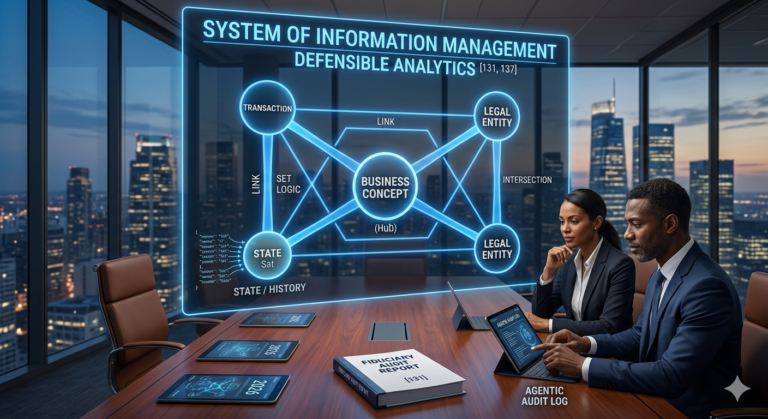


What Is a System of Information Management and Why Governance Alone Cannot Provide Defensibility at Scale
Organizations increasingly recognize that managing analytics and data as isolated projects or governed by policy alone fails to ensure long-term defensibility. A System of Information Management (SIM) is an enterprise-level construct designed to preserve the meaning, lineage, and accountability of data and analytics artifacts over time. It extends beyond governance frameworks by embedding auditable evidence and operational stewardship into the flow of information, enabling organizations to withstand scrutiny from regulators, auditors, and boards.
Understanding SIM as a system rather than a set of tools or policies reframes modernization success toward sustained clarity and trust in information assets. This FAQ addresses common executive questions about the scope, accountability, scalability, and governance implications of SIM, clarifying why governance alone cannot provide the defensibility required at scale.
What exactly defines a System of Information Management at the enterprise level?
A System of Information Management is a coordinated organizational capability that integrates people, processes, and technology to maintain consistent, auditable records of data definitions, lineage, transformations, and usage. It is not merely a governance framework or a compliance checklist but a living system that captures and preserves the context and rationale behind information artifacts as they evolve. This system ensures that data and analytics outputs retain their intended meaning despite organizational changes, platform migrations, or analytic model updates.
SIM operates as an enterprise-wide system of record for information assets, providing contemporaneous evidence rather than retrospective narratives. It requires clear roles, decision rights, and accountability mechanisms embedded in operational workflows. Without this systemic approach, organizations risk definition drift, loss of audit trails, and weakened accountability as scale and complexity increase.
Why do governance frameworks alone fall short of ensuring defensibility in large enterprises?
Governance frameworks articulate intent through policies, standards, and oversight bodies but do not inherently generate the evidence needed to prove compliance or explain decisions. They often rely on manual documentation, periodic reviews, or post-hoc reconciliation, which become brittle as organizations grow and change. Governance alone cannot prevent or detect subtle shifts in data meaning, lineage breaks, or unauthorized modifications without an integrated system capturing these details in real time.
Moreover, governance frameworks frequently face incentive conflicts where short-term delivery pressures overshadow investments in stewardship and system maturity. This leads to gaps between stated policies and operational realities. The absence of a system that operationalizes governance into auditable, repeatable processes creates vulnerabilities exposed during audits, regulatory inquiries, or AI-driven analytic validation.
How does organizational scale and complexity impact the need for a System of Information Management?
As enterprises expand through mergers, reorganizations, and technology evolution, the volume and velocity of data and analytics artifacts multiply. This growth amplifies risks of definition drift, inconsistent lineage, and fragmented accountability. Without a system that enforces alignment and preserves context, the cumulative effect is a loss of trust in information outputs and increased exposure to regulatory and reputational risk.
Scale also introduces political and operational trade-offs. Enforcing system-wide standards and controls requires political capital, reduces local autonomy, and slows perceived delivery velocity. These trade-offs are often deferred or softened to maintain short-term agility, but the resulting fragmentation undermines long-term sustainability. A System of Information Management confronts these tensions by making explicit the costs and benefits of alignment at scale.
Who holds accountability within a System of Information Management, and how does this differ from traditional governance roles?
Accountability in SIM is distributed across roles with clearly defined decision rights embedded in operational processes rather than residing solely with governance committees or compliance functions. Data stewards, architects, analysts, and business leaders share responsibility for maintaining the system’s integrity through their actions and decisions. This contrasts with traditional governance, which often concentrates accountability in oversight bodies detached from day-to-day operations.
This distributed accountability model requires explicit authority boundaries and incentives aligned to sustain stewardship behaviors. It also demands transparency mechanisms that surface compliance and risk issues promptly. Without this operational embedding, governance risks becoming symbolic rather than substantive, eroding defensibility under scrutiny.
What are the risks of neglecting a System of Information Management when adopting AI-driven analytics and modernization initiatives?
AI-driven analytics increase the complexity and opacity of information products, making lineage, explainability, and auditability more challenging. Without a SIM, organizations rely on fragmented documentation and informal knowledge, which cannot reliably support post-hoc explanations demanded by regulators or boards. This gap exposes enterprises to compliance failures, flawed decision-making, and loss of stakeholder trust.
Modernization initiatives focused on delivery speed often deprioritize investments in stewardship and system maturity. This creates a fragile environment where rapid changes introduce definition drift and break lineage chains. The absence of a defensible system of record transforms explanations into narratives vulnerable to challenge. Recognizing this risk reframes modernization success as the ability to sustain meaning and accountability, not just to deploy new technologies.
A System of Information Management is an enterprise capability that preserves the integrity, lineage, and accountability of data and analytics assets over time. It transcends governance frameworks by embedding auditable evidence and operational stewardship into daily workflows, enabling organizations to maintain defensibility under scrutiny. Governance expresses intent, but only a system of record provides the evidence necessary for sustained trust and compliance. Understanding and investing in this system-level construct clarifies why past approaches, effective at smaller scales, struggle under complexity and growth, and why governance alone cannot bridge that gap.